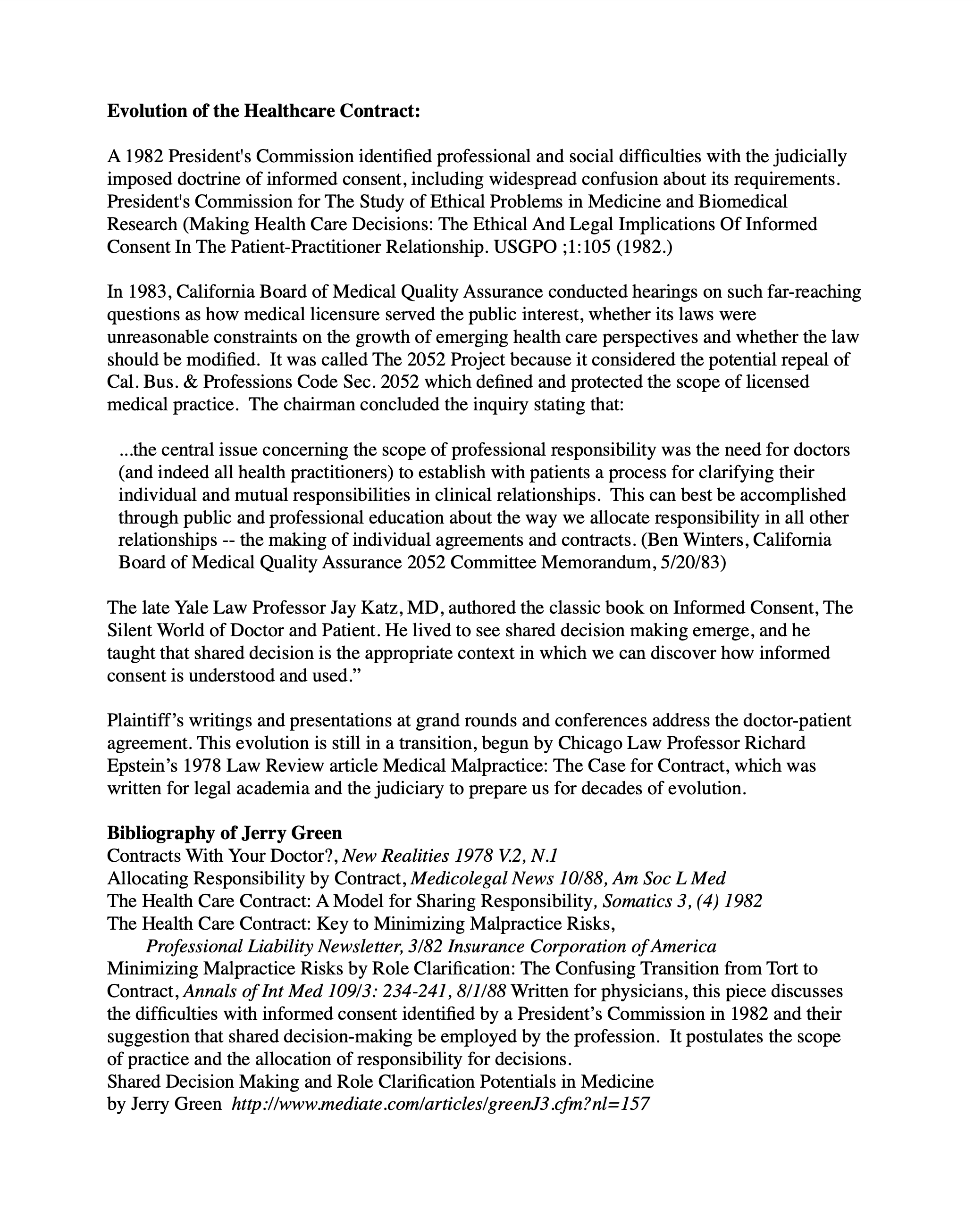
Evolution of the Healthcare Contract
by Jerry A Green, J.D.
In 1983, California Board of Medical Quality Assurance conducted hearings on called The 2052 Project because it considered the potential repeal of Cal. Bus. & Professions Code Sec. 2052 which defined and protected the scope of licensed medical practice. The chairman concluded the inquiry stating that: "...the central issue concerning the scope of professional responsibility was the need for doctors (and indeed all health practitioners) to establish with patients a process for clarifying their individual and mutual responsibilities in clinical relationships. This can best be accomplished through public and professional education about the way we allocate responsibility in all other relationships -- the making of individual agreements and contracts." (Ben Winters, California Board of Medical Quality Assurance 2052 Committee Memorandum, 5/20/83) This evolution is still in a transition, begun by Chicago Law Professor Richard Epstein’s 1978 Law Review article Medical Malpractice: The Case for Contract, which was written for legal academia and the judiciary to prepare us for decades of evolution. The enclosed documents writings and presentations at grand rounds and conferences that address the doctor-patient agreement.
Click To Read Article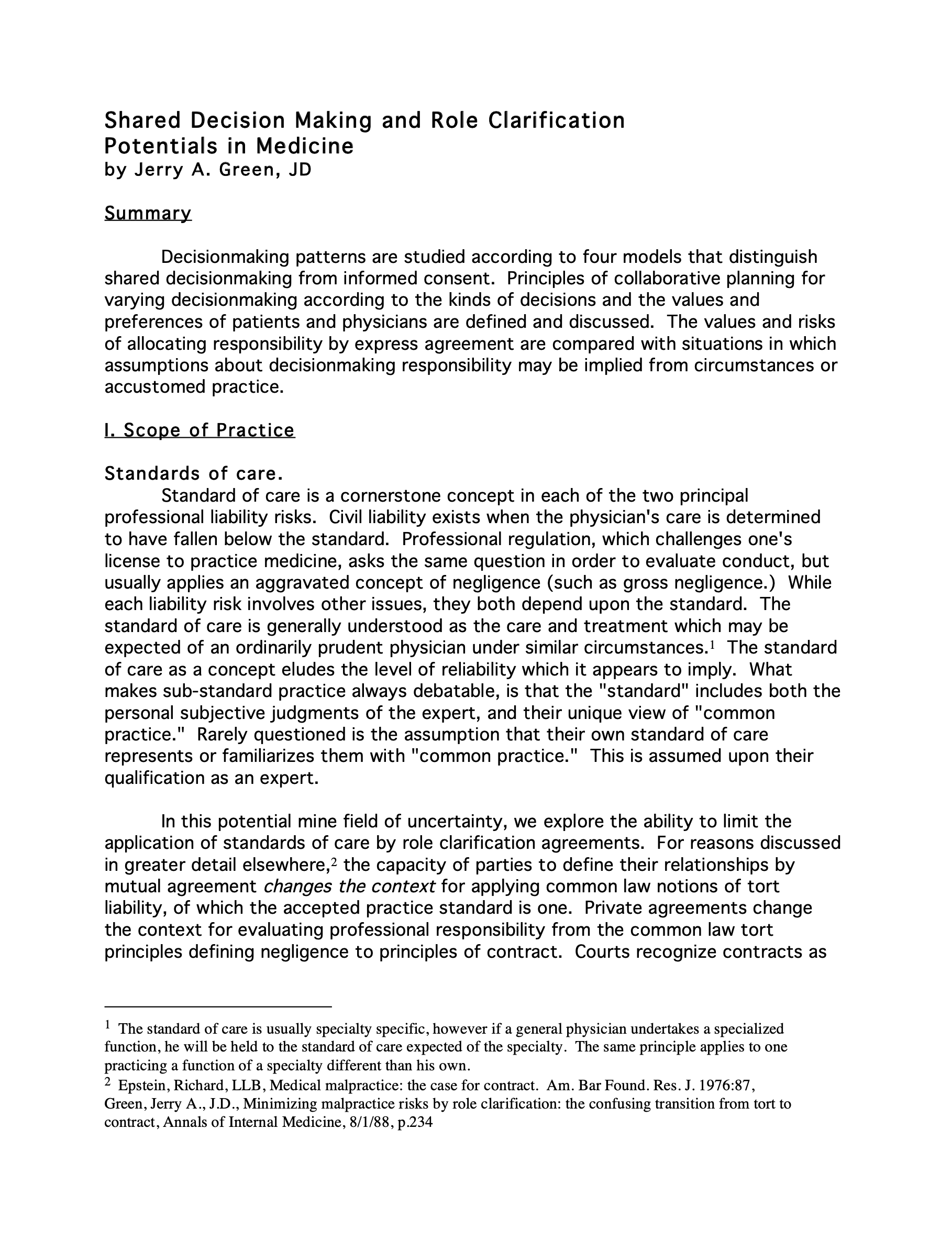
Shared Decision Making and Role Clarification Potentials in Medicine
by Jerry A Green, J.D.
Shared Decision Making and Role Clarification Potentials in Medicine explores our ability to limit the application of medical standards of care by role clarification agreements. The capacity of parties to define relationships by mutual agreement changes the context for applying common law notions from tort principles to principles of contract. Three common styles or models of making decisions, familiar to us in in other relationships, are compared here: collaboration, patient choice and the traditional professional assumption of responsibility according to standards of care.
Click To Read Article
Medicine And Holistic Practice
by Jerry A Green, J.D.
A collection of articles applying contract to clarifying scope of practice in medicine and holistic health practices documenting the defense of holistic practitioners in the 70’s and used to encourage independent professional identity thereafter based on Harris Coulter’s articulation of scientific assumptions that distinguish reductionist medicine from vitalist practice (Divided Legacy: History of the Schism in Medical Thought.)
Click To Read Article"Your professional education at Grand Rounds in at UCSF was extremely enlightening and very effective in defining the various roles played by each person."
- Edward C. Hill, MD Professor Emeritus, University of California, San Francisco
"There exists between doctors and patients certain identifiable patterns of misunderstandings which generate unrealistic expectations, adversity and litigation. The remedy for these misunderstandings is role clarification and collaborative planning. This makes the practice of medicine more interesting and more fun.”
- Dermatologist David Elpern, MD
"I am fortunate to have found Mr. Green, who is a fruitful source of ideas on successfully structuring health care practice. He is unusually talented in explaining these ideas In an educational format. He listens to client concerns, analyzes them cogently, and suggests approaches succinctly and effectively."
- K. Lee Peifer, Heath Care Attorney
"Jerry equalizes the playing field for Plaintiff's in medical malpractice cases; a great source of expert referrals. He helps immensely with identifying and focusing on the issues where experts are needed. Medical malpractice is a technical field, and I don't take it on without him. He is the best!""
- John K. Crowley, Attorney
"Long overdue; a cure for deteriorated patient-physician relationships."
- L. Kyle Gambrell, DO, ENT
This early exploration of the Neighborhood Law Office’s attempt to identify legal inroads to social change only to discover limits in foundational property rights, reveals the authors’ personal interest in representing movements of positive social change, which like today, may not reflect the flow of dominant political currents.
Click To Read Article